Power Supply for Building Automation: Supply and Charge Via USB
February 22, 2024
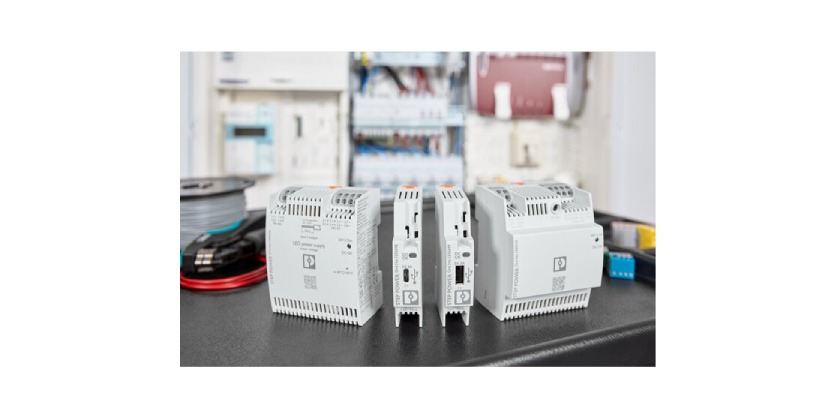
The Step Power power supplies from Phoenix Contact are tailored to the needs of modern building automation. They supply smart meter gateways, Raspberry Pis, and other smart home components via the USB port. In addition, they can be used for the fast charging of mobile end devices and other 5 V loads.
The power supply unit has a USB-A or USB-C port for up to 15 W. Using it as a USB charger provides more space in the distribution board, control cabinet, or flat control panels due to the particularly narrow overall width of just 18 mm (1 HP). This completely eliminates the need for the classic combination of an electrical outlet with an overall width of 45 mm (2.5 HP) and a USB power supply unit. The integrated cable groove with strain relief in the housing of the power supply enables the USB cable to be routed easily under the cover of the distribution board, if required – thus simplifying handling.
With low no-load losses of <0.1 W and a high degree of efficiency, the Step Power power supplies offer optimum energy efficiency in buildings. Due to effective energy savings achieved as a result of maximum efficiency in no-load operation and partial-load operation, the power supplies meet the stringent requirements of the efficiency standards of the Ecodesign Directive. The large wide range input of 85 V AC … 264 V AC and the temperature range of -25 to +70°C also enable worldwide use in almost all ambient conditions.
Power supplies for building automation
Supply and charging via the USB port
The STEP power supplies supply power to both Raspberry Pis and smart home components via the USB port. In addition, they can be used for the fast charging of mobile end devices.
Main features
- No-load losses: <0.1 W
- USB-A and USB-C connection flexibility
- Max. output power: 3 A
- Overall width: 18 mm
- Wide temperature range: -10°C … +70°C
Your Advantages
- Two connection methods: USB-A and USB-C
- Easy installation in the subdistribution with an integrated cable groove in the housing
- Significant space savings in the control cabinet through use as a USB charger
- Energy savings with the highest level of efficiency in no-load and partial-load operation (Efficiency Level VI)
More Information
Related Product
Power Supplies for Extreme Ambient Conditions from Phoenix Contact
The third generation of power supplies sets a new standard in machine building. The power supplies are compact, robust, reliable, and impress with their easy handling. With the protective-coated PCB, the new power supply ensures high system availability, even under extreme ambient conditions. The coating protects against dust, corrosive gases, and humidity. Failures due to creepage currents and electrochemical migration caused by corrosion are also prevented.