Festo’s new PCRP is one tough filter regulator for many harsh environments
August 12, 2019

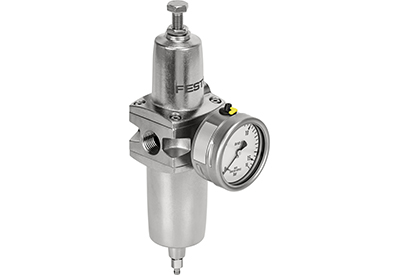
Corrosive atmospheres, extreme temperatures, explosive zones, indoor or outdoor applications: Festo’s PCRP filter regulator delivers high flow rates and reliable compressed air pressure control in a range of harsh environments. Its housing and interior are made entirely of premium stainless steel to ensure high corrosion resistance. The UV-resistant PCRP functions reliably outdoors and at temperatures ranging from -60°C to +80°C. Its also built rugged for potentially explosive zones 1, 2, 21 and 22.

The PCRP’s stainless steel 316L housing meets all material requirements to NACE MR0175, guaranteeing a high level of corrosive resistance even in hydrogen sulphide environments such as those in the petrochemical industry.

The PCRP combines filter and pressure regulator functions in a single space-saving design, with a flow rate up to 4,115 l/m and a grade of filtration 5 or 40 µm, depending on which ISO 8573 air quality compliance level is required. The unit’s patented seal technology protects against back flow and ensures reliable exhausting without the need for special accessories.

Installation is simple and fast. The PCRP has two pressure gauge connections for mounting flexibility. It can be installed in-line or using the available simple mounting bracket. Once it’s in place, there is just the pressure gauge (Festo’s PAGN) to be screwed in. Pneumatic connections are either ¼” or ½” in G or NPT.
Related Articles


Editor’s Pick: Featured Article

Weidmüller’s u-control 2000: The Automation Controller

Weidmüller’s u-control 2000: The Automation Controller

Weidmüller’s scalable engineering software, u-control 2000, adapts individually to your requirements. And, the u-control is powerful, compact and fully compatible with Weidmüller’s I/O system u-remote. This article looks at what makes u-control the heart of your automation.

Programmable logic controllers (PLCs) are one of the main components of any automated system. A typical control system has inputs, outputs, controllers (i.e., PLCs), and some type of human interaction with the system, a human machine interface (HMI), for example.

Read More


Latest Articles

  • How Motor Pole Count Influences Speed and Torque in Servo Motors

    December 9, 2025 Servo motors deliver precise, repeatable motion, and their performance is shaped by how torque, speed, and stability interact under load. One structural element that defines this behavior is motor pole count. Pole count determines how the magnetic field rotates inside the motor and how much torque the motor can produce at different… Read More…

  • Digital Revolution in Transformer Substations

    December 9, 2025 The energy sector is under a lot of pressure. German distribution grid operators need to get their infrastructure ready for the energy transition and fast. By 2030, some 80 percent of electricity is to be generated from renewable sources. A pilot project at naturenergie netze GmbH is demonstrating how transformer substations can… Read More…