Trio’s New Motion-PLC the Best of Both Worlds: Precise Motion and Simplified Logic
October 29, 2025
By Krystie Johnston
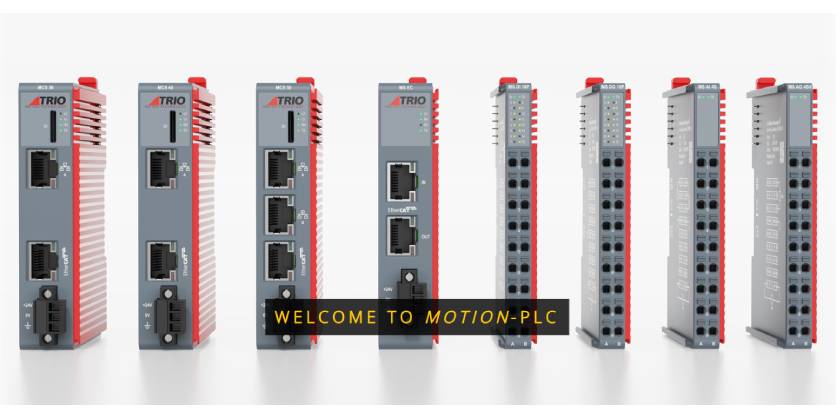
Trio Motion Technology has been manufacturing high-quality motion controllers since 1987. Headquartered in the United Kingdom, the company also has offices in the United States, India, China, Bulgaria, and Italy. Since being acquired by the Estun Group in 2017, the company has grown significantly in size and value, while maintaining their brand that has become synonymous with motion. Trio recently launched their Motion-PLC range, a new class of controllers designed to provide advanced motion control with the functionality and simplicity of a PLC, ushering in a new era of controllers.
“Our company, and our core DNA, is motion,” says Tom Alexander, President and Managing Director of Trio Motion Technology. “We always think about motion first. And motion controllers have traditionally been somewhat different compared to PLCs. They have been centered on managing the movement of machines as opposed to managing the auxiliaries, like sensors, other on/off switches, and the logic associated with a machine that has typically been managed by a PLC.” Motion-PLC changes that.
Alexander says managing the motion of the machine – whether it be 10, 20, or 100 axes of motion working together, or three or four axes of motion working in a complicated, interpolated way – is what Trio sees as the most difficult aspect of controlling a machine. He says that Motion-PLC represents an opportunity for Trio to bring the motion closer to the logic, at a competitive price point.
“In the marketplace, we have seen a lot of people struggling with traditional PLCs trying to do what we do,” Alexander says. “We have taken on the mantle by saying, ‘Why don’t we integrate logic with our motion control specialization and provide people with a PLC-type environment that allows them to do the things that they are used to doing, the logic and the ladder programming that they are comfortable with, alongside our motion capability that manages the more complicated parts of the machine?’ With this approach, integrating motion and logic into one controller makes it much simpler for them.”
Motion-PLC is born
Alexander says several features have been integrated to ensure flexibility and scalability depending on the machine or group of machines their customers are trying to control.
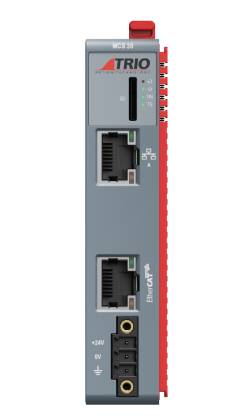
Flexible Machine Motion Coordinator, Ideal for simple machines
Specifically, Trio’s new controllers feature up to two Ethernet ports with fieldbus support for HMI and upstream devices, including Modbus TCP, PROFINET I/O, and Ethernet I/P; in addition to extensive I/O integration to expand machine connectivity, according to their latest press release.
In addition, easy programming of complex motion makes Trio’s Motion-PLC adaptable to a variety of complex applications. For example, Motion-PLC can be programmed in familiar PLC languages that follow the IEC 61131-1 standard, and the controllers also include a PLCopen motion library. Alexander explains that their controller stands out against other manufacturers’ products because they have honed it to make certain applications easy to create and execute, combined with Trio’s motion control performance.
“Within our motion environment, there are a lot of features and functions that are very applicable to different application areas,” Alexander says. “If you were a packaging company – which we have quite a few customers in Quebec – then you would find a lot of dedicated commands within our language for creating packaging machines. Whether they are vertical form fill and seal machines, bagging machines, or wrapping machines, you will find dedicated commands.”
Alexander adds that these dedicated commands within their language (TrioBASIC) and their core IP (Motion-iX), make it easier to create and optimize applications. Combining this with the IEC language steps this up a notch. “Now, people who are used to IEC and ladder programming do not have to sacrifice the simplicity of a high-level language like TrioBASIC. They can integrate them both together,” he says. “I think that is fundamentally what is new. It is a new product. It has a lot of features that make it better and easier to use; the way it goes together, the simplicity of the programming and the user interface, the easy way the connectors work. All that is new and fresh.”
A new class of controller
What are some of the industries that will benefit most from Trio’s new Motion Coordinator?
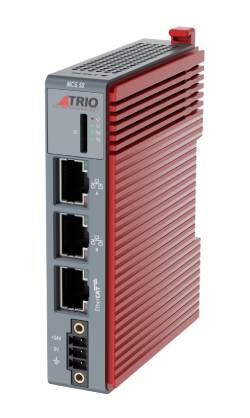
Alexander says Motion-PLC is especially primed for the small machine market, like the packing industry. The MCS 30, for example, is an ideal motion coordinator for simple machines like point-to-point or pick-and-place applications (up to four axes). And the MCS 40 and MCS 50 are ideal for stand-alone sub-machines like gantries with low to medium axes (up to eight axes). He says that Motion-PLC can be used in other industries, but points to Trio’s range of products that support the varying complexities of motion control technology.
Alexander says Trio also has a PC-based motion controller range, traditional motion controller products, and what they call a ‘Flex range,’ which he describes as a flexible range of controllers with I/O add-ons, geared towards end users who are making a variety of different machines and need to configure the controller in different ways for different machine options.
While the new Motion-PLC is aimed at controlling smaller machines for designers more used to a PLC format, Trio’s capability extends to coordinating as many as 128 servo axes over EtherCAT. And they continue to research and develop new products as their customers’ needs change. For example, Trio’s full automation solution also includes a SCARA robot range, as well as servo drives & motors, I/O solutions, and HMI.
Alexander says that Trio will be dropping their next set of controllers in the New Year, which will be another boost to their product range. “There is another range of controllers coming out to sit alongside the MCS 30, MCS40, and MCS 50, which add a few more functions and features into the controller – mainly around the hardware – so you can have higher performance hardware closer to the controller,” he says.
“We have effectively two sub-families of controllers: we have a set of controllers in the 30, 40, and 50, which do not come with any I/O/. You just add the I/O with slices according to what you need. But with the next drop of controllers, which will be out just in the New Year, they will come with integrated I/O.”
Trio Motion Technology in Canada
Trio Motion Technology has a growing presence in Canada; they have several reputable distributors they have worked with for years, and they are hiring more sales representatives in Quebec, adding more resources to support the ones they have in Ontario, and are active in the Atlantic provinces as well. Alexander says they appreciate that recent trade challenges with the United States are having an impact on Canadian businesses, so they are looking to improve the way they sell their products in Canada.
“Most of our products – except for the servo drives and motors – are made in the UK. So, we benefit from the UK country of origin. We can sell quite effectively in the US, but now we realize that we need to sell differently into Canada,” Alexander says. “We have some traditional links from Britain into Canada; we obviously want to exploit that. We want to make it easy for us to succeed in Canda. And we think that Canda’s industry represents a significant market to us that we can grow in.”
Alexander says there is a good opportunity for the UK and Canada to partner, and he is exploring ways to grow this relationship. “Canada has tried to become more open with Europe – even though we are not in the EU anymore. We still see that the Canadian economy wants to be a trading economy, so we think it is stable to communicate and trade with them.” In fact, at the time of writing this article, Alexander was on his way to Toronto to meet with sales reps there and discuss how to support them more.
What Trio sees on the horizon
Alexander says that developments in the sector aren’t typically an instantaneous revolution; they happen over time. Looking back, the pivotal moments of inflection and change become more obvious. What Trio is doing today is improving their products, adding more features and functions, and making them more relevant to more types of machines and verticals. Looking forward, Alexander says he sees augmented reality and artificial intelligence as two technologies emerging on the horizon that will have an impact on the future.
These technologies are already being used and developed. For example, Alexander explains that Trio works with Apple in China, and they wanted to be able to commission machines remotely. So, Trio developed a solution with Apple that leveraged augmented reality: Apple’s Vision Pro glasses. “They [Apple] wanted to be able to do design reviews remotely, both looking at the real machine and seeing the virtual machine – a digital twin,” he says. “When we show that technology at any exhibition, I am pleased with how much interest people have in it. It really allows people to not just do design reviews remotely, but to commission remotely as well.”
Developing this solution further, Alexander says that artificial intelligence is being used to translate languages in real time, enabling people from different languages and locations to speak with each other in real time to design and commission machines. “We were able to translate someone talking in Chinese, and the text coming up on the screen was in English. That was quite good, because they [Apple] wanted to be able to commission machines in Vietnam where the Vietnamese did not speak Chinese,” Alexander says.

Trio is also integrating artificial intelligence into their programming language as well, making it easier for people to create and edit programs. “One of the core costs people have in creating machines is the engineering time. The time it takes to write the program, the time it takes to switch from one controller to another, and so on,” he says.
“If you wanted to move to a Trio controller, one of your considerations would be how long it would take. We want to create the ability to do that quickly and simply. This can be achieved with IEC languages, as well as Trio’s high-level, English language programming, and increasingly with AI assistance.”
Alexander says these developments will have positive impacts on the automation industry. And he is looking forward to seeing how Trio will grow in the future.
More Information
Interested in learning more about Trio? Visit their website today!
Related Story
First Controllers in Trio’s Motion-PLC Range Simplify the Design of Stand-Alone Machines
Trio Motion Technology has launched the first controllers from its new Motion-PLC range, designed to provide advanced motion control performance with the functionality and simplicity of a PLC. The new class of controller combines high-performance motion control over EtherCAT plus logic and I/O expansion, enabling faster, simpler machine development.
The first models in the range, which are now available to order, comprise the MCS 30, the MCS 40, and the MCS 50 Flexible Machine Controllers. The three controllers scale machine and motion requirements up to eight axes over high-speed EtherCAT.